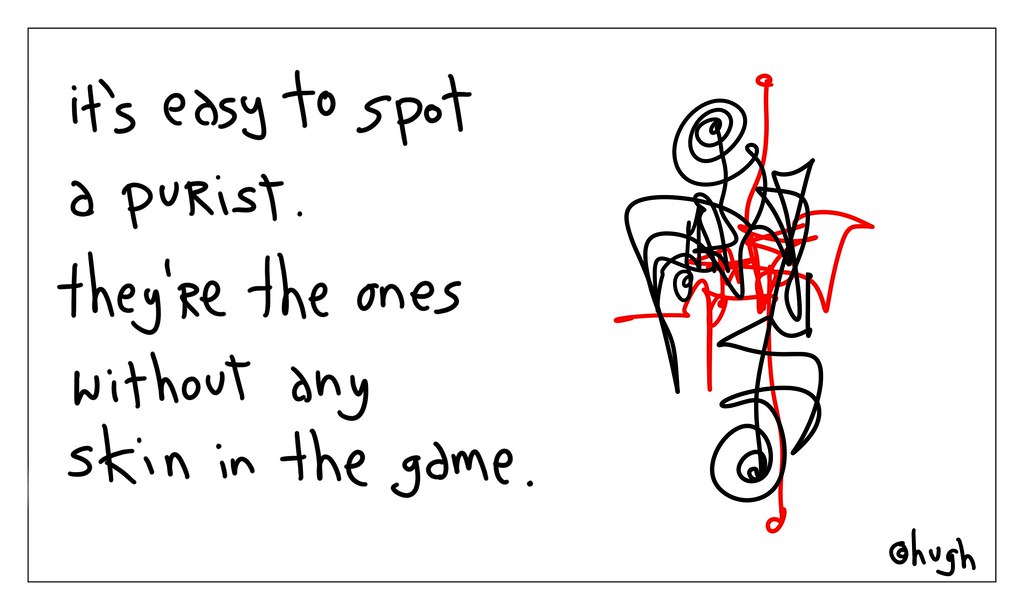
If anyone counts as a ring leader for emerging global microbrands it is Hugh MacLeod. Hugh is a creative, a prankster, high end management consultant and wine merchant all rolled into one. What is a global microbrand?
The Global Microbrand is nothing new; they’ve existed for a while, long before the internet was invented. Imagine a well-known author or painter, selling his work all over the world. Or a small whisky distillery in Scotland. Or a small cheese maker in rural France, whose produce is exported to Paris, London, Tokyo etc. Ditto with a violin maker in Italy. A classical guitar maker in Spain. Or a small English firm making $50,000 shotguns.
With the internet, of course, a global microbrand is easier to create than ever before. A commercial sign maker in New England. Or a sheet metal entrepreneur in the U.K.
Why is Hugh so inspiring? Because his core message is simple. If we work damned hard at something we’re good at we can all grab a place at the big kids’ table. The internet will make us findable if we use it right. That doesn’t mean acting big, or trying to look big. It doesn’t mean calling ourselves “the world’s leading” this or that. Leave the overblown adjectives to bad advertising and PR practitioners. Keep it simple like
Cartoons drawn on the back of business cards
The business cards thing is important because it shows the way forward to random acts of traction. Most business cards are instantly forgettable – file and forget, and perhaps don’t even file. Hugh’s cards on the other hand hang around. Just like his blogs. Or some words of advice from five years ago. Hugh has an amazing network of people that want to help him out, because he gives so much away. Some take advantage of course, but that’s human nature.You can take Hugh’s images and stick them in your cubicle– or put them on a t-shirt, or a wall in a bar, a Windows 7 theme or whatever the shit you want to. No problem. All that Hugh asks is that you don’t resell these images. There is absolutely no contradiction that Hugh also sells limited edition prints.
The reason I have had this post in mind for a while is that Hugh, unlike 99% of the people I talk to, actually understands RedMonk’s model at a gut level. He never asks “but how do you make money when you give all your content away”. He never tells me I should put up a paywall for our content. In fact Hugh would laugh at the idea. I can’t tell you how many times my business partner Stephen and I have had to explain to people how the model works. With a lot folks they still don’t get it. And yet – we have been running RedMonk for 8 years now. Obviously not sustainable then.In his Random Acts of Traction post Hugh nails it:
As they can only realistically execute on 10% of their ideas, they don’t seem to mind giving away the remaining 90% for free, via their blogs. If one of their free ideas gets “Random Acts of Traction”, it’s great PR for their businesses. It leads to conversations eventually. Conversations that eventually lead to paid gigs.
That’s right- conversations lead to paid gigs. Sales 101 perhaps, but a lot of folks seem to forget the basics. Pay for play – euch. Some of these conversations are long-running. My favourite example is our seminal creative commons licensed Compliance Oriented Architecture [pdf warning!] report. We interviewed a ton of people, then effectively gave the content away. We allowed for commercial use- EMC used the report as the basis for a white paper and didn’t need to pay us. Nearly two years later I got a call from Thomas Otter, a guy that worked for SAP (he is at Gartner now). He wanted to use COA as the basis for a customer discussion. I met him for a glass of wine at Bedales, and about two weeks later I was in Walldorf at SAP’s HQ. Today SAP is a valued customer but I would never have got in the door if we hadn’t “given away” our research product. Its also worth nothing that SAP doesn’t engage with us as analysts, but as influencers through a great program run by the inestimable Michael Prosceno.
Frankly you have to have some skin in the game in order to play by the new rules. Because RedMonk makes so much solid content freely available our business model doesn’t scale in the same way more publishing oriented research firms work. We are often told that fact makes us beholden to people that pay the consulting bills. But I would rather advise companies, and declare commercial interests, than claim that we don’t rely on vendor revenues. Our model is the new patronage economy. We like to thank our sponsors. If we didn’t take Big Company money we couldn’t spend our time hanging out and learning from the people that really matter in our business- software developers.
We are not purists, but we’re an ethical company, small as we are, which helps us punch far above our weight. That’s good enough for me.
disclosure: rumour is RedMonk may feature in Hugh’s next book Evil Plans. Skin in the game, see.
monkchips says:
September 25, 2009 at 11:09 am
thoughts on being a tiny company but a global player. its easy to spot a purist http://bit.ly/AIHdv #evilplans
This comment was originally posted on Twitter
ccmehil says:
September 25, 2009 at 11:15 am
maybe little but huge impact my friend @monkchips http://bit.ly/AIHdv
This comment was originally posted on Twitter
gapingvoid says:
September 25, 2009 at 1:02 pm
Great post by @monkchips re. “Random Acts of Traction” http://bit.ly/1aaaDA
This comment was originally posted on Twitter
andypiper says:
September 25, 2009 at 1:10 pm
Liking Mr Governor’s (@monkchips) post about Redmonk business model http://bit.ly/AIHdv with a nod to @gapingvoid Random Acts of Traction
This comment was originally posted on Twitter
FellowCreative says:
September 25, 2009 at 1:18 pm
Great post James.
Thank you for the insight, its good to know I’m not alone in my mindset =)
I’m not sure if I’m write but I think ‘Its also worth nothing that SAP doesn’t engage with us as analysts’ should be ‘Its also worth NOTING that SAP doesn’t engage with us as analysts’ – please forgive me for being as bold as to try and correct but I had to read it twice… I may of course be wrong?
Positive thoughts,
Carl @FellowCreative
PS. Congratulation on the book feature. I look forward to reading more about Evil Plans =)
SavioRodrigues says:
September 25, 2009 at 1:23 pm
So glad that I took 2 min to read @monkchips latest post – needed the inspiration today: http://bit.ly/rTzYI
This comment was originally posted on Twitter
CampLeadership says:
September 25, 2009 at 1:23 pm
Great post by @monkchips re. “Random Acts of Traction” http://bit.ly/1aaaDA (via @gapingvoid)
This comment was originally posted on Twitter
monkchips says:
September 25, 2009 at 1:26 pm
if you want to inspire people, first be inspired by others. getting lots of love for my @gapingvoid inspired post today http://bit.ly/AIHdv
This comment was originally posted on Twitter
fellowcreative says:
September 25, 2009 at 1:28 pm
EXCELLENT POST! > if you want to inspire people, first be inspired by others… http://bit.ly/AIHdv (via @monkchips)
This comment was originally posted on Twitter
vinnie mirchandani says:
September 25, 2009 at 1:45 pm
Global Micro-Band – like the term! Though I think there needs to be some qualifier about how many countries the person has visited (Leo at SAP is up to 80, I think – in my hobby guest series I had someone who has been to voer 100!), how many country visitors he/she has blog readers/Twitter followers etc
BTW – there is growing recognition of “micro-nationals” -firms being spawned with key executives in different countries – borderless, way more reach than 5-10 years ago.
mrchrisadams says:
September 25, 2009 at 1:50 pm
“if you want to inspire people, first be inspired by others” Brilliant post – http://bit.ly/1cJzoe
This comment was originally posted on Twitter
Nelsonb says:
September 26, 2009 at 1:14 pm
its easy to spot a purist http://bit.ly/mLlV7
This comment was originally posted on Twitter
B2BGuys says:
September 26, 2009 at 7:04 pm
Dogear Redmonk blogs (@monkchips) “It’s easy to spot a purist. They’re the ones without any skin in the game.” http://bit.ly/3dZFkJ
This comment was originally posted on Twitter
Jon Reed says:
September 27, 2009 at 9:40 pm
One of the best posts I have seen in a while, thanks James. I too have been following Hugh and his thinking on microbrands and there is a lot to it.
As someone who has a lot of respect for the Redmonk/Greenmonk model, it’s good to hear you say what many of us are hoping for: that sharing good content leads to a good business direction.
I give away a ton of content on my site, in my case, I did it first and foremost because I get a great deal of satisfaction out of sharing what I hope is quality information. But you’re right on, James, it has certainly led me deeper into industry conversations (in my case SAP) and eventually to clients. Sometimes it feels a bit roundabout, but perhaps the roundabout is far more direct in the long run than any other route, I don’t know. It certainly feels more soulful and personal than other ways I have done business in the past.
When I started doing it, it was more a labor of love than an intentional business strategy, but when I read posts like yours, it makes me think that there actually is a very coherent business strategy to come out of this, particularly when you rub up against analyst services, where so much of it historically has been behind firewalls.
On the other hand, not all of this is positive, depends a lot on the industry. Just the other day I got a very depressing visit in my office from an exceedingly talented musician who is struggling to make sense of an industry where his audience (aka “fans”) feel entitled to have all his music for free. “Let him sell t- shirts” seems to be the response of his “supporters.” On the other hand if/when I accrue more assets, I’d be inclined to fund some of his ventures myself, so maybe that is part of what you mean by the patronage economy?
So that particular blade can cut both ways, but it seems to be working well in this industry and I am glad to be a part of this at a time when a firm I respect as much as yours can do so well, while coming off with a real independent spirit…and a simple and worthy philosophy you could write on the back of a business card. 🙂
– Jon
jonerp says:
September 27, 2009 at 9:45 pm
Commented on @monkchips’ excellent “It’s easy to spot a purist,” http://bit.ly/1a7rt2, with a nod to @gapingvoid and “global microbrands.”
This comment was originally posted on Twitter
MarkYolton says:
September 28, 2009 at 8:54 pm
Interesting blog by @monkchips at http://bit.ly/1aaaDA which mentions “… the inestimable Michael Prosceno.”
This comment was originally posted on Twitter
DigitalSignals says:
September 29, 2009 at 8:14 am
Just read RedMonk blog on “acts of traction” Good read, thanks for sharing @monkchips Stick to what you believe in – http://bit.ly/TGCge
This comment was originally posted on Twitter
deanflynn says:
September 29, 2009 at 9:04 am
Inspiring ideas – RedMonk blog on “acts of traction” from @monkchips http://bit.ly/TGCge (via @DigitalSignals)
This comment was originally posted on Twitter
DE says:
October 4, 2009 at 8:04 pm
The execution percentage is quite an important bit, because it goes both ways.
If I make public the best business idea ever, those with the bandwidth to look will either not be on that road, or will understand it because they are already doing much of it. The conversations both parties get in the latter case are much more useful than a one off, one sided limited advantage.
omniprasan says:
October 13, 2009 at 5:33 pm
New Sales 101 | RedMonk| its easy to spot a purist http://bit.ly/mLlV7
This comment was originally posted on Twitter